

Everyone is a math person.
Differentiation that enables teachers to support students in catching up while keeping up with grade-level math.
—
Amplify Desmos Math helps teachers build a classroom of students who see themselves as math people.
Our approach
—
Amplify Desmos Math views differentiation as an ongoing process where teachers are both reactive and proactive to student needs, ensuring that all students have clear pathways to proficiency. Through rich data and teacher support, Amplify Desmos Math uses flexible categories of intervention and enrichment that adjust daily according to student thinking.
In-the-moment differentiation supports are available for every lesson, both digitally and in the print Teacher Edition.
In-lesson differentiation
—
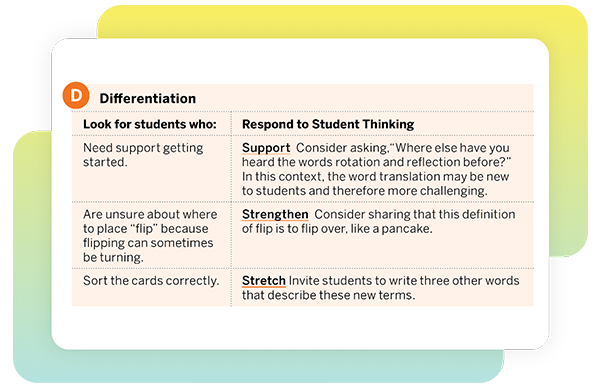
Within every lesson activity, teachers can use the Differentiation Teacher Moves suggestions to provide in-the-moment instructional support while students are engaged in the work of the lesson.
Teachers are provided with clear student actions and understanding to look for, each matched with immediately usable suggestions for how to respond to the student thinking illustrated in each row of the table. In addition to using these suggestions in the moment as teachers monitor student work, teachers can review the Differentiation table in advance to help them anticipate how students are likely to approach the activity.
Teachers have data at their fingertips to guide and differentiate instruction.
—
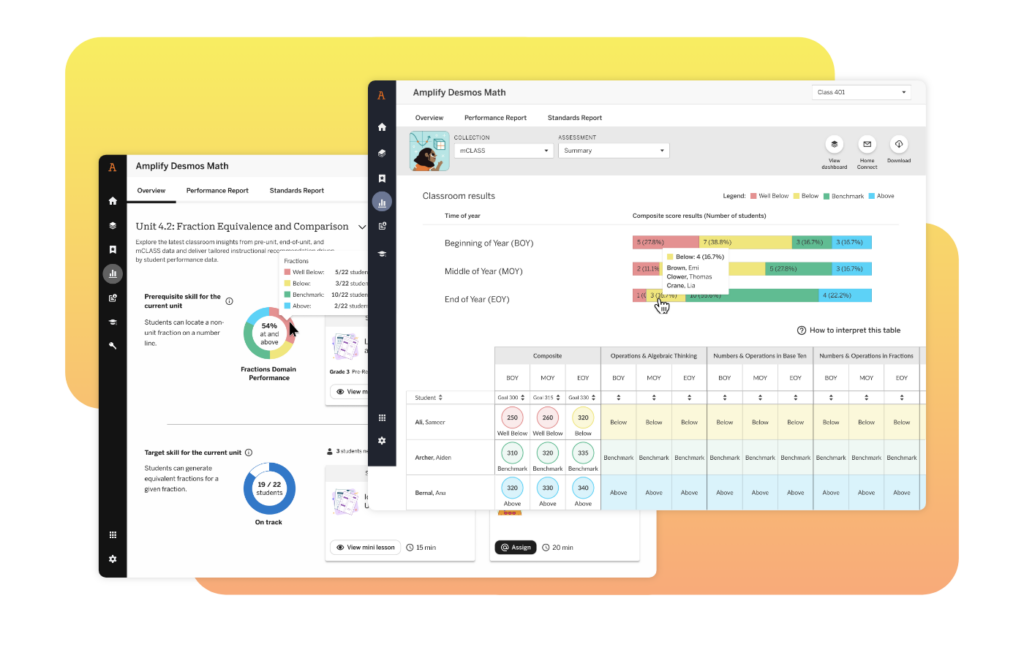
Amplify Desmos Math Reporting provides teachers and administrators with unified data insights so that educators have visibility into what students know about grade-level math. Areas of potential student need are highlighted to allow teachers to modify their instruction and target differentiated support.
Planning for intervention with Support, Strengthen, and Stretch
Mini-Lessons
Prior-grade Mini-Lessons to support students’ learning
—
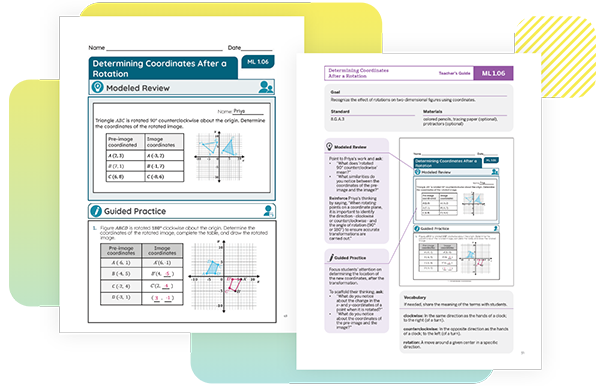
Amplify Desmos Math Mini-Lessons are 15-minute lessons aligned to the most critical topics throughout a unit. Teacher-led Mini-Lessons are used to provide targeted intervention to small groups of students who need additional support or to re-engage students with content that they may need more time on.
High school teachers have access to Mini-Lessons aligned to prerequisite skills and concepts for each course in Amplify Desmos Math. Mini-Lessons are the perfect complement to our problem-based approach, because they provide more explicit instruction opportunities and leverage a consistent instructional routine (Modeled Review, Guided Practice, Check for Understanding).
Extensions
—
All students should have access to fun and challenging problems. Amplify Desmos Math extensions are 10- to 15-minute activities aligned to the most critical topics in a sub-unit. Extensions can provide targeted intervention to small groups of students ready for an extra challenge or the whole class.
Amplify Desmos Math extensions build on our student-led, problem-based approach, providing more opportunities for students to engage in creative and rigorous problems that can be approached with different strategies.
These low-lift activities give teachers flexibility and provide students with open-ended, hands-on problems they can choose from.

Multilingual/English Learner supports
—
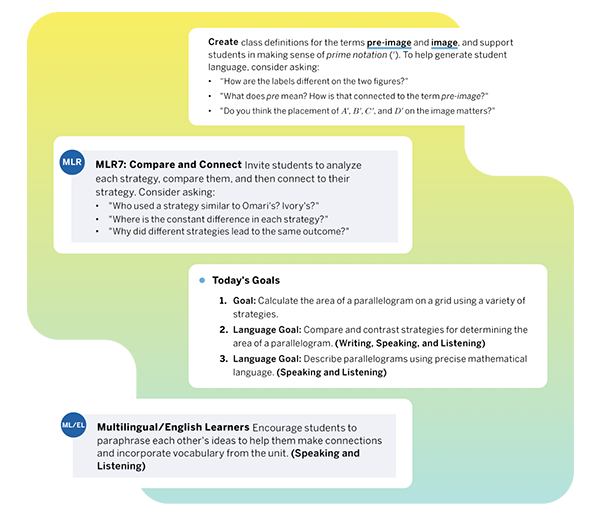
Supports for multilingual/English learners (ML/ELs) are called out at intentional points within each lesson. These suggested supports are specific, targeted actions that are beneficial for ML/ELs. They often describe a modification to increase access to the task or provide support with contextual or mathematical language development that can often be helpful to all learners. ML/EL supports may also be attached to Math Language Routines.
Amplify Desmos Math Math Language Development Resources provide
additional support for integrating math language acquisition and development
into each lesson. These scaffolds and supports target moments of listening,
speaking, reading, and/or writing designed to benefit all students, including
those building English language proficiency.